Monday, 1 June 2020

The Making Of… Fantastic Voyage

Having received several requests for more information on how the set for my Fantastic Voyage 7TV2 game was made, this is a short post to show how it was all put together. Although I wasn't planning to write this post, fortunately I did take a few pictures during the construction process as you can see below.


The set of Fantastic Voyage (well, my version of it)


For complete information about this game, please also take a look at the two related posts Fantastic Voyage - A Solo 7TV Game which describes a play-through of the game and Fantastic Voyage - The Episode which sets out rules for playing this as a 7TV2 episode.


What I needed for this game is set out in the second of the above posts. Briefly (apart from a copy of the 7TV2 Spy-Fi rules), these were:


- The crew: five miniaturised scientists from the Combined Miniature Deterrent Force;

- The Proteus mini-submarine;

- Terrain representing a microscopic view of a part of the inside of a defecting Soviet scientist's brain, comprising:

- Base cloth

- Impassable bits of body tissue terrain

- The brain wall

- Red blood cells

- Antibodies


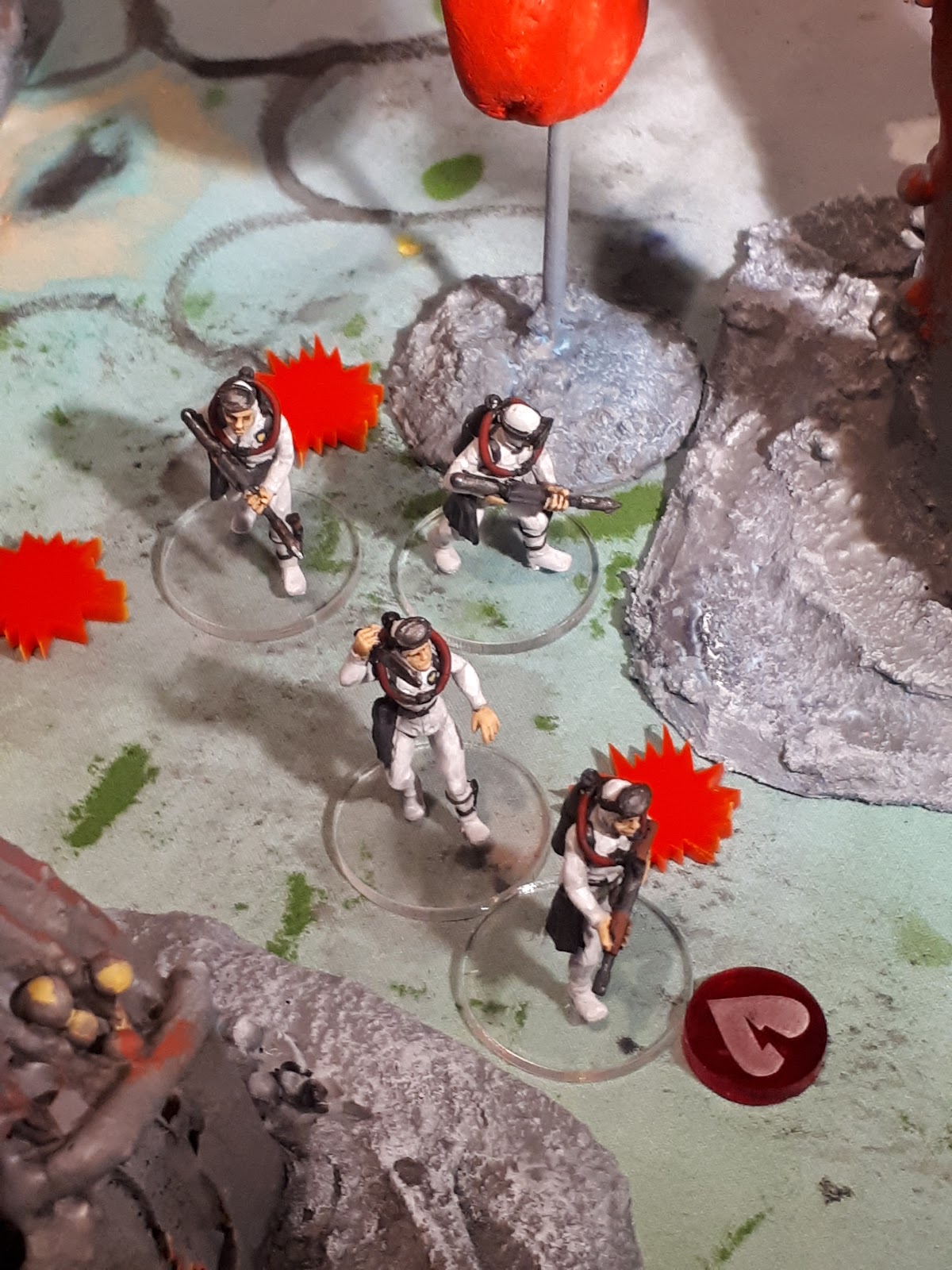
The Crew


Nobody, it seems, anywhere, makes 28mm swimming scuba diver figures - which is a real shame because I would love to be able to play the final scene in Thunderball as a wargame. Please, if anyone knows where to get these figures, let me know!


The crew of Proteus, immediately after painting


But the Scuba Diver figures made by Crooked Dice are excellent and perfectly suitable for this game. Although their equipment isn't exactly the same as those in the film, mine are painted in colours approximating the uniforms of the crew of the Proteus in Fantastic Voyage.


 U-91035 Proteus


Now I know I could have got hold of a really excellent model of Proteus from one of several 1:50 scale kits that exist or get one specially 3-D printed, and that the sub would have then looked identical to the one in the film. But that's far too easy. No, seriously, for reasons of both cost (I'm not going to play this game enough to warrant significant expense) and time (as always I am in a hurry to play with my toys) I decided instead that it wouldn't be too difficult to make one out of card scraps and paper mache. 


I always seem to think this, and then do my best to prove myself wrong. It's harder than I thought. Hence, the results are just a bit rubbish - but then if I am trying to simulate what Fantastic Voyage  might have been if it had been made on a considerably smaller budget, I might be getting close.


Component parts of Proteus, cut from cardboard


The first step in making Proteus was measuring components to get it the right size. My original concept was that the submarine would have a removeable roof so that you can stand the crew figures inside. It turns out you don't need to do this for the game, so it really doesn't matter, but this defined the size of the sub - there was no attempt to measure it to scale.

Basic assembly of the body of Proteus


You'll notice that some of the ideas of how I thought Proteus was going to look changed as the model was built. This is what happens when you design the model while you make it. The engine pods above, for example, were initially made in card but removed later and replaced with (far more suitable) lengthwide-split biro lids. 

And all stuck together (roof removed)


I used UHU all purpose glue to stick the card together. It's pretty quick-setting (much more so than PVA) although can be a bit stringy (even though it says it isn't). 


Once stuck together, all of this was covered with paper mache (newspaper/PVA) applied once, then dried, then made good and applied again. This massively strengthens the model as well as making good most of the gaps. The whole model was then painted white.


The design process continues as the model is built


As you can see, there are some fairly major design changes to the roof between the photos above and below. The roof was cut back to allow for the much larger windows that Proteus has in the film. I build a frame for the windows out of MDF (not the best choice of material in hindsight). The top and bottom hatches were added using wooden discs and some spare bases, and the engines (made of biro-lids that were split lengthwise) added to the top and bottom of the 'wings'. You can also see I reshaped the tail fin completely using pieces of mounting board.


Proteus takes shape


When all that had dried, I made liberal use of Milliput to smooth off the front of the submarine, add slightly domed finishes to the hatches, fill in gaps and tidy edges. This also added weight to the whole model, which was useful. Once this was dried, the only elements missing were the glazing and the observation dome, and the front intakes and what I presume are outtakes at the base of the tail fin.


Tidied up with Milliput

The whole model was spray painted white. I then cut pieces of clear plastic (for some reason the best I had available of the size required was from the tray that some crumpets originally came in) for the front windows (attached with super glue) and the removeable plastic lid of a drinks bottle for the dome. Far from perfect (especially as it has holes in if you look carefully) but it will do. Front and rear vents (not shown in the picture) were made from corrugated cardboard cut to size and fitted in place with more Milliput. Hatches painted yellow, vents and some small squares on the sub upper surface painted black, and Proteus is ready for launch.

Finishing touches added

Base Cloth

Modern art

With regret, I failed to take any pictures of my attempt at modern expressionist art in the garden that was required to make the basecloth. It was quite fun.  The base cloth started as a length of sheet that had previously been used as floor protection when decorating. It wasn't very clean and already had paint spatters. I added to this by soaking it in used painting water and then spreading it out in the garden on a sunny day and throwing the lurid-coloured contents of several unwanted acrytlic paint pots at it. After it dried (strange laundry on the line that day) I painted some nerve-cell-like shapes all over it in black and coloured them appropriately. This would represent the brain.

The base cloth was cut to 3ft wide, but over-length, so that I could hang it over a vertical frame to represent the brain wall (described below) on which the game objectives would be placed.

Brain Wall

One of a pair of frames

Having found some lengths of wood I made two 18" wide open rectangular frames with this anmd attached them to MDF bases. Two sections so that it would fit in a box for storage. These would form the brain wall. The idea is that the base cloth overhangs this and a string of LED fairy lights sit inside it to give the idea of nerve activity (a bit like in the film). 

Both frames, with backs added

Backs, made from foamboard, were added to these frames. And that's pretty much it.

The fairly lights go inside the frame, with the base cloth overhanging. I've added further effect by draping some torn pieces of material (formerly a snow effect table cover bought from Poundland that I knew would be useful sometime) across it. These are also useful for attaching the blood clots to, and for something so simple it's pretty effective (see below).

Divers approach the brain wall, which is lit up with nerve activity

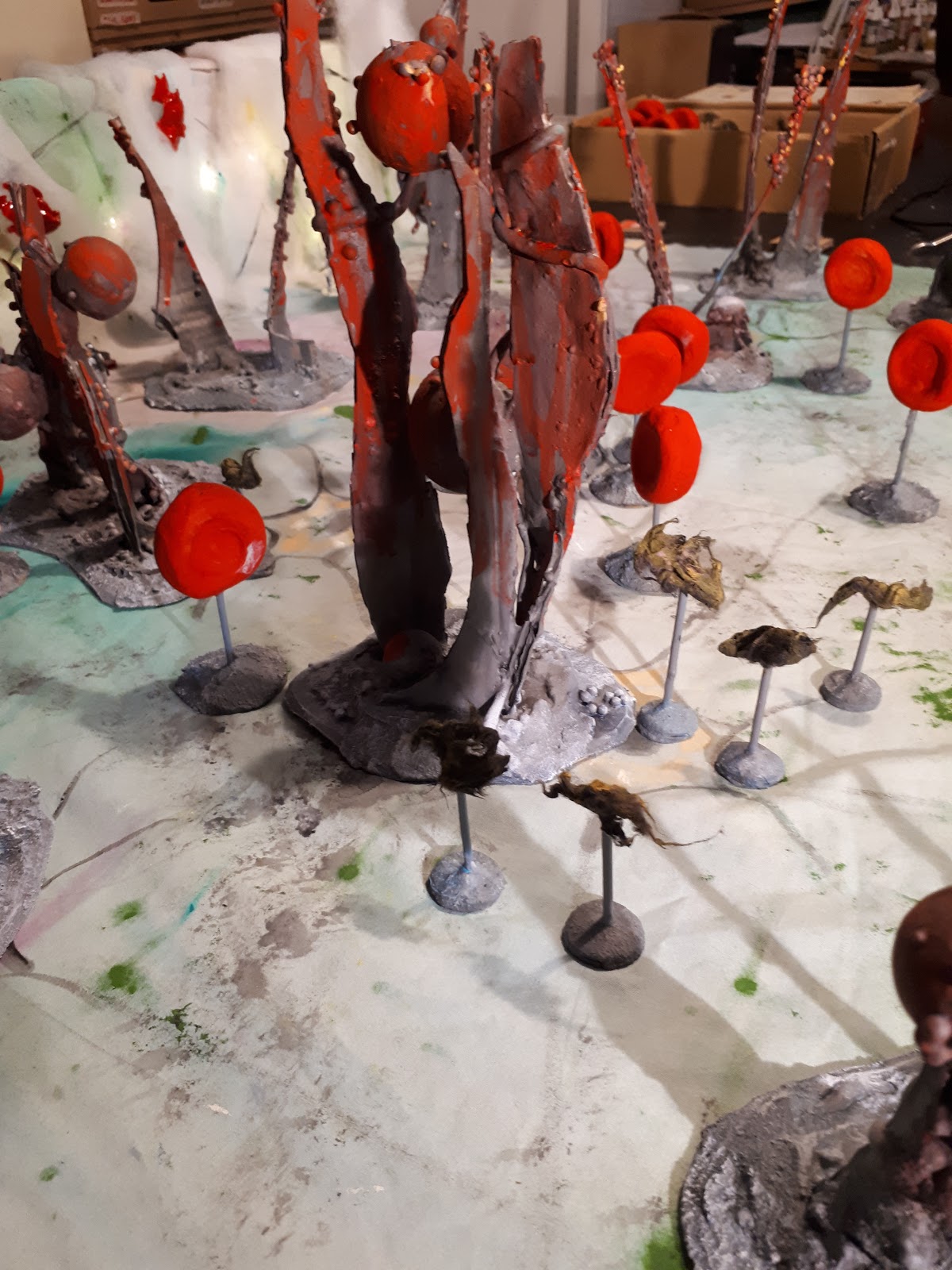
Body Part Terrrain

This terrain was made with absolutely no attempt to in any way accurately depict the inside of the human body.

I cut some leaf-like lengths of card and stuck them to MDF bases cut to size. About 15 of them altogether - I wasn't sure whether the game would work best on a 3x3 or 4x4 table at that time so was hedging my bets.

Original concept in progress

As, even after priming grey,  these looked to me a bit too much like aquarium plants, I modified them considerably by using up a load of polystyrene balls of various sizes and some florists wire, all attached with PVA. There might have been some paper mache in some of these as well. The blobby effect makes them look like nothing familiar and therefore perfectly suitable for this use, and they might perhaps also be useful as some weird sci-fi terrain setup in a future different game.

Drying the whole assembly

PVA is very handy stuff but anyone who has used it with cardboard will be all too aware that before it dries it soaks in and can make the card very floppy. This is not useful when your terrain mostly comprises long lengths of card that you want to stand up on end. The solution is shown in the image below. Cardboard boxes and clothes pegs to allow the terrian sections to hang upside down to dry.

One of many examples of the strange things wargamers get up to

Once dry, I textured the bases with sand/PVA mix, and then spray-painted them with red and grey. Spot-highlights were added in yellow, red, purple and lime green, and the whole dry-brushed light grey and white to highlight and better blend bases with the base cloth. 

Red Blood Cells

A box of blood

These are made from DAS air-drying clay. Just bear in mind they take about a week to dry, but apart from that they're great. Each is made from a small ball of clay about 1" wide, squashed flat-ish with a central indent in each side.

Lots of stands

Bases were made in the same way for red blood sells and antibodies (see below). First, I took a wooden disc (of appropriate size - about 40-50mm for red blood cells - and added weight to this by glueing a 2p piece (1p for antibodies) to it. The wooden disks were bought very cleaply in bulk from The Works, by the way. When dried, a length of wooden kebab stick (various lengths, so as not to be too uniform about the height of things floating about in the blood stream) was then stuck to this with a glue gun. Bases were textured with sand/PVA mix as for the terrain above.
Red blood cells

When dry, these were painted grey and highlighted with light grey and wite dry-brushing. The red blood cells were painted a very bright red.

Antibodies

A reasonable amount of thought went into how to represent something that was represented in the film as variously a lighting special effect and pieces of semi-transparent green rubber. I settled on cotton wool.

Not what it looks like
    
You can make quite effective smoke in the same way as this. I took some cotton wool balls and soaked them in some watered down black acrylic paint. These were then squeezed out in kitchen roll and left to dry. When dry, small bits of them were pulled and teased apart and stuck to the top of their bases. Bases were made in the same way as described for red blood cells above, but using smaller 15mm-ish wooden disks weighted with 1p pieces. These were smeared with dabs of bright green and bright yellow paint to result in something approximating the look of antibodies from the film.

These have absolutely no resemblance to real antibodies, by the way.

Antibodies (they'll do)


Blood Clots


I went one step further than necessary here by making some blood clots for use as objective tokens, that could be attached to the brain wall. These started life as blobs of glue from a glue gun, which were made good once set with more glue (UHU), and then trimmed to tidy up when they had dried. 


Blood clots in prep


These wre painted bright red (same as red blood cells), and finally gloss varnished.


Blood clots hanging on the brain wall


And that's it! Everything's ready to play!

Monday, 18 May 2020

Fantastic Voyage - A Solo 7TV2 Game

Fantastic Voyage - a solo game of 7TV2
Here is the narrative and pictures of one of several games that followed a week's work during lockdown, which was the result of what I can only describe as a moment of madness. I like these modelling and gaming challenges, but I honestly thought this one would be easier; with more time and considerably larger spend the result of this project might have looked a lot more professional, too. Please therefore consider this as what Fantastic Voyage might have been if it had been made by the BBC special effects dept on a particularly small 1960's Dr Who budget.

This is the second of two related posts - this one that describes the narrative of a game, mostly in pictures, and the pother setting out the rules by which the game was played. Enjoy!

THE PLOT SO FAR

During the cold war, a Soviet scientist who has perfected a technique for shrinking things has defected to the West. Unfortunately he was attacked on the way and is now in a coma. A blood clot needs to be removed from his brain or he will die - but the only way the clot can be operated on is to use the scientist's own techniques to shrink five members of the Combined Miniature Deterrent Force (CMDF) and a repurposed submarine called Proteus to tiny size, inject them into his bloodstream, and get them to use surgical lasers to remove the clot from the inside. They then have to escape safely before they expand to normal size, and it's a race against time as they can only remain that small for an hour. Travelling through the heart and the inner ear to the brain, they have to contend with the body's defences, and what's more, there's a saboteur on board as well.

The adventure (or at least, the way it turned out on one occasion of playing) is best told in pictures.


The Proteus approaches the brain wall, where the blood clots that must be removed can be seen. Proteus moves easily through the more open areas of this capillary but body tissues become denser closer to the brain wall.


Grant, Dr Michaels, Dr Duval and Cora Peterson leave the submarine via the air lock. Red blood cells flow all around, some of them dangerously close to the Proteus. If they collide and cause a disturbance, antibodies will soon arrive.


Equipped with surgical lasers, the divers swim closer to the brain wall, taking care not to disturb the sensitive body tissues. Nerve cells flicker with light as they approach.


A red blood cell bumps gently against the Proteus, doing no damage, but the ripples cause antibodies to be attracted.

Cora's laser appears to be ineffective, but Grant burns part of one of the blood clots away. Using the surgical laser can clear the obstruction efficiently, but the vibrations it causes inevitably disturb the bloodstream and antibodies begin to gather. In the distance, Dr Duval and Dr Michaels work to weaken another blood clot.


Antibodies gather, attracted by the disturbance cause by the surgical lasers.


Another round of surgical laser shooting proves less effective. The clots here are more resilient and stubbornly remain in place.


A distant view of the action as seen from Captain Owens at the helm of the Proteus.


Numerous antibodies close in on Cora, whose efforts to shift one of the blood clots prove unsuccessful.


It's time to get moving! Cora alerts Grant that they need to hurry.


Without warning, Dr Michaels' body goes limp - oxygen is leaking from his tank and he has momentarily lost consciousness. Stunned and weakened, with the last of his awareness he seals the leak, but this can only be sabotage!


Working together, Cora and Grant clear one of the blood clots entirely, but a large number of antibodies are closing in and one clot has to be abandoned. Grant turns his attention to a second clot while Cora makes her way in his direction.


Further along the brain wall, Dr Michaels has recovered thanks to his smelling salts (it's not clear how he used them in the diving suit, but we will gloss over that). He and Duval get to work together on another blood clot.


A distant view across the body tissues.


Antibodies swarm around in the bloodstream, hunting for targets.


Antibodies start to close in on Cora, who beats it quick in Grant's direction.


The Proteus attempts to move to a more protected location, but antibodies are dangerously close.


A mass of antibodies is generally drifting toward the Proteus.


The same moment, from a different angle.


View of the whole table and game in progress. I'm not sure what the sellotape is doing there.


Dr Duval and Dr Michaels clear another blood clot. Cora swims past Grant toward them.


Another red blood cell blunders into the Proteus, and this time antibodies attack. Behind, others home in on the disturbance.


Grant, determined to remove just one more clot before he leaves, finds himself in a dangerous position. Despite antibodies close by, he destroys the clot with laser fire, and then deploys a grapple gun to pull himself out of position away from the antibodies and closer to the rest of the crew.


Working together, the divers clear a fourth blood clot from the brain wall.


Antibodies start to build up on the hull of the ProteusCaptain Owens starts to worry. Many more and Proteus will be unable to move.


Their job done, the crew pull away from the brain wall. They know that time is of the essence and they need to get back to the submarine soon.


Proteus slowly pulls away, a mass of  antibodies attached to its hull, as yet more close in. Captain Owens calls on the radio for the divers to hurry back.


Masses of antibodies that have built up relentlessly pursue the Proteus.


Job done, at last our heroes swim back between body tissues toward the submarine.


But there's a twist in the plot - Cora swims up behind Grant and stabs him in the back with her diver's knife. She's the saboteur, secretly working for the Soviets, and intent on the mission failing! Now we know why her laser was so ineffective earlier!


Unfortunately for her, Cora is closely followed by Dr Duval, who manhandles her away from Grant and leaves her for dead in the water. The saboteur has been dealt with, but the massive disturbance this has caused means that antibodies are already homing in.


Wounded, Grant makes it back to the Proteus, which continues to accumulate antibodies.


At the back, Dr Michaels is attacked by an antibody. Weakened, and with more pursuing, he makes his way back toward the Proteus with all speed.


As time runs short, Owens, who has left Proteus, does what he can to clear antibodies from the hull using his laser, while Duval accompanies Michaels back to the submarine.


At this point the Fan Favourite card is drawn from the deck - and there's only one way to interpret this. In another twist of fate, this can only mean that the beautiful Cora isn't dead at all (this traumatic loss of eye candy at such a critical point in tjhe film would have been very bad for ratings) but has in fact been saved by Grant, who manhandles her unconscious body back through the Proteus airlock. She'll survive to be passed to the authorities to be dealt with when they return to normal size. And so, with just enough antibodies removed to enable Proteus to make its escape, the remaining crew swim aboard.

It's the final turn, and the last Countdown Card is drawn: Inevitable Explosion. Somewhere, something explodes - but Proteus leaves the table safely and the episode ends.

The patient is saved. The crew and the Proteus have survived. The saboteur is sent to be dealt with by a military court, and the reputation (and future budget) of the CMDF is secured. A resourding victory for the good guys.

But that is only one possible outcome of the episode...